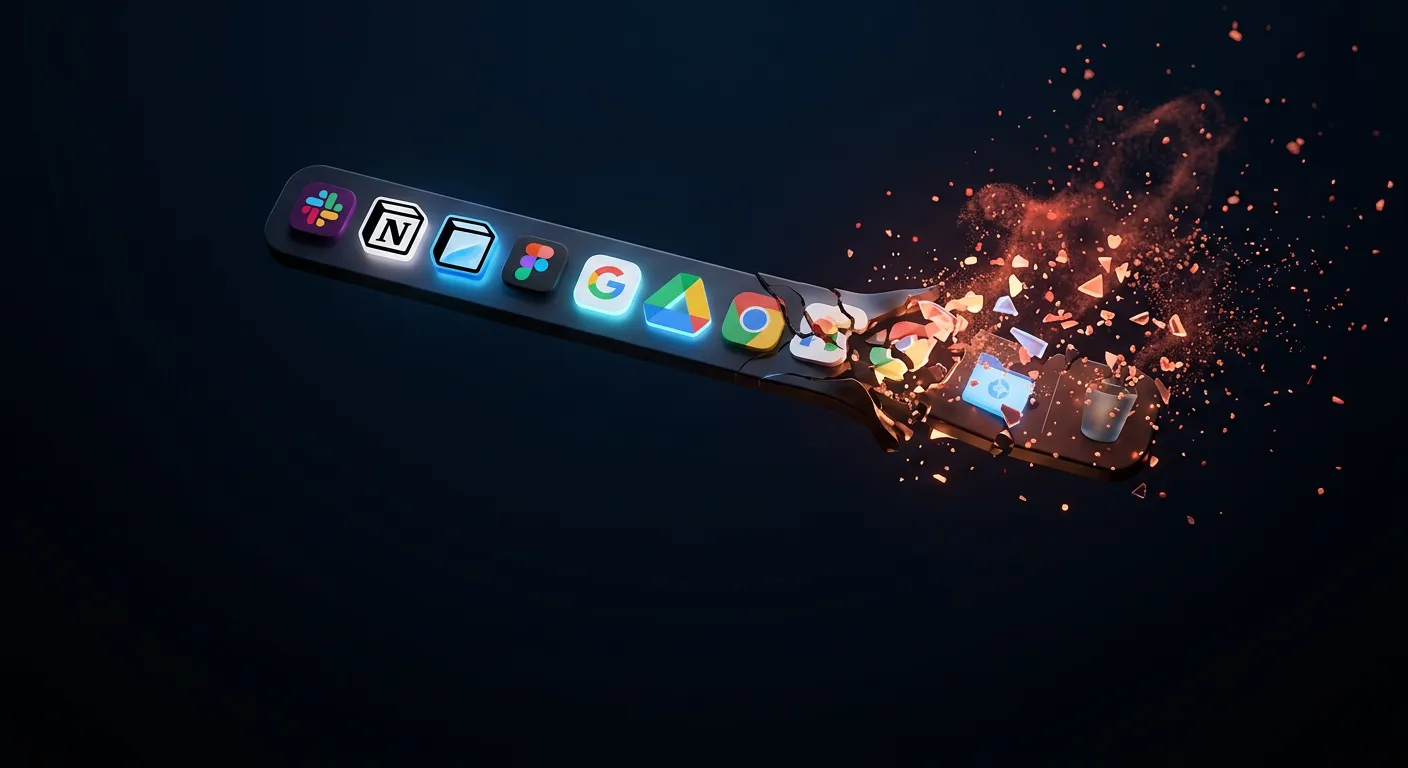
The App Store Is Dying: Why Your Next 'Software' Won't Be Software
The average company now runs 106 SaaS apps, large organizations push past 447, and over half of those licenses go unused. That works out to roughly $21 million per org per year on software nobody opens, which is a staggering number when you say it out loud.
I think we all quietly know this is broken. We just can't picture the alternative because we've been staring at app grids since the iPhone trained us to think of software as colored squares.
The $2 Trillion Wake-Up
Roughly $2 trillion in market cap evaporated from software stocks between mid-January and mid-February 2026. In the first week of February alone, the S&P 500 Software Index dropped 13% across five trading sessions, erasing over $800 billion in market value. Atlassian fell 36% amid AI disruption fears, Salesforce shed 28%, and Adobe lost more than a quarter of its value.
I don't think this was a normal correction. When Anthropic's Claude Cowork, which launched in January, triggered a market panic on February 3rd, enterprise software stocks dropped $285 billion in a single day. Later, Microsoft followed with Copilot Cowork on March 9th at $30 per user per month, and its CEO, Satya Nadella had said the "notion that business applications exist" could "collapse," and when the CEO of the world's largest software company says apps might not be a thing anymore, that's worth paying attention to.
I believe the market is pricing in something specific: the end of seat-based software. Seat-based pricing dropped from 21% to 15% of SaaS models in a single year, with 2.3x higher churn for companies sticking to the old model. Companies that once needed 500 licenses are achieving the same output with 50, and the economics of that are hard to argue with.
Why You Can't See It Coming
I keep thinking about functional fixedness from cognitive science. The more you've practiced using something a specific way, the harder it becomes to imagine an alternative. If you've spent five years mastering Salesforce dashboards, your brain resists the idea that a conversational agent could replace that workflow. You don't just lose the tool, you lose the identity built around knowing it.
This is why most people hear "AI agents" and picture a chatbot bolted onto their existing apps, a slightly better search bar. That's status quo bias, the preference for the current arrangement even when the alternative is measurably better.
What's actually being built is something different. Anthropic released the Model Context Protocol in late 2024 as a standard way for agents to interact with apps, and it now has millions of monthly SDK downloads. OpenAI adopted it, Google confirmed support, and by December 2025 it was donated to the Linux Foundation. Then in February 2026, WebMCP was proposed as a W3C standard that turns any web page into something an agent can interact with directly. The infrastructure for agents to use your apps on your behalf is an industry standard now, and Jensen Huang's line about IT departments becoming "the HR department of AI agents" is starting to feel real.
The Messy Middle
While all this plays out, the situation currently remains a bit messy.
Gartner projects that over 40% of agentic AI projects will be cancelled by end of 2027. Workers already spend 4.5 hours per week cleaning up AI mistakes, what people are calling "AI workslop." Klarna bragged about a chatbot replacing 700 support agents, then quietly reversed course and started re-hiring humans.
I think Fortune got it right when they described the whole narrative as "more like a Russian novel" than a simple displacement story. Agents aren't eating SaaS, they're building an orchestration layer on top of it. The apps don't vanish, they become plumbing that agents interact with so you don't have to. This should save human effort.
Workers switch between apps 33 times per day on average, and 17% switch over 100 times, with each interruption costing about 23 minutes of recovery. Context switching alone costs the U.S. economy an estimated hundreds of billions annually, which is a genuinely wild number. I don't think agents will fix all of this, but even fixing half would be enormous.
What This Means for You
If you're a young professional, you're facing a real question: invest in mastering specific tools, or invest in learning how to orchestrate agents? I think the answer is probably both, but the balance is shifting fast. Most enterprise apps will have embedded agents by year end, up from very few in 2025.
Dario Amodei mentioned that over 90% of the code at Anthropic is now written by Claude. I think about that a lot, not because coding is going away, but because what "using software" means is dissolving in real time.
Consider the icons on my dock. Each one represents a company that believed it was selling a product, when what they were really selling was a workaround for the fact that computers couldn't understand what you needed. Once they can, the app grid starts looking like a relic. Not tomorrow, not cleanly, and not without plenty of workslop along the way, but the $2 trillion the market just erased suggests the bet is already placed, and it's not on more apps.